Fort Brooke in 1824, the city charter of 1855 and 1887, Ybor City's cigar factories and all 82 Tampa listings on the National Register of Historic Places.
Last checked Oct. 10, 2026. History comes from the City of Tampa’s brief history and the City Clerk’s incorporation history; landmarks from the National Park Service’s National Register spreadsheet (listings through May 22, 2026).
Tampa began as an Army post on the bay, grew rich on railroads, phosphate and cigars, and still has whole neighborhoods from those years. Four local historic districts and 64 local landmarks are protected by the city, and 82 places with Tampa addresses are on the National Register of Historic Places.
Who to call
- City historic preservation: Architectural Review and Historic Preservation, 813-274-3100, option 3
- City archives and records: Office of the City Clerk, 813-274-8030
- Tampa Bay History Center: 801 Water St., open daily 10 a.m. to 5 p.m. (tampabayhistorycenter.org)
How Tampa began
From the city’s history page and the City Clerk’s incorporation history:
| Date | What happened |
|---|---|
| 1513 | Spanish explorer Ponce de Leon reaches the Tampa Bay area |
| Jan. 18, 1824 | Col. Brooke, James Gadsden and four infantry companies arrive; Fort Brooke is set up to guard the harbor |
| Jan. 18, 1849 | Fourteen men vote to form the Village of Tampa |
| Sept. 10, 1853 | Residents organize the Town of Tampa |
| Dec. 15, 1855 | Gov. Broome signs the first City of Tampa charter |
| Feb. 22, 1862 | Confederate military authorities suspend the city government |
| Aug. 11, 1873 | Residents vote to reincorporate as the Town of Tampa |
| 1884 | Henry B. Plant’s railroad reaches the Hillsborough River |
| 1886 | Vicente Martinez Ybor opens a cigar factory |
| July 15, 1887 | The present City of Tampa is organized, merging the Town of Tampa and the Town of North Tampa |
Phosphate discoveries in the late 1880s brought mining, shipping and a boom through the 1890s. Tampa was the main port where U.S. troops shipped out for Cuba in the Spanish-American War, and Jose Marti spoke to cigar workers from the steps of Ybor’s factory. In 1914 the St. Petersburg-Tampa Airboat Line started what the city calls the world’s first scheduled commercial airline service, and a building boom from 1923 to 1926 produced subdivisions such as D.P. Davis’s man-made Davis Islands.
The historic districts
The city’s local historic districts are Ybor City, Hyde Park, Seminole Heights and Tampa Heights, reviewed by the Architectural Review Commission and the Barrio Latino Commission (historic preservation page). The city describes Ybor City as about 2 square miles between Nebraska Avenue, 22nd Street, Columbus Drive and East Broadway. The National Register also lists the West Tampa, Hampton Terrace, North Franklin Street, Upper North Franklin Street and Palmetto Beach districts.
Every National Register listing in Tampa
From the National Park Service data, by year listed. Addresses are as the register records them.
| Property | Address | Listed |
|---|---|---|
| Circulo Cubano de Tampa | 10th Ave. and 14th St. | 1972 |
| El Pasaje | 14th St. and Palm Ave. | 1972 |
| Ybor Factory Building | 7th Ave. between 13th and 14th Sts. | 1972 |
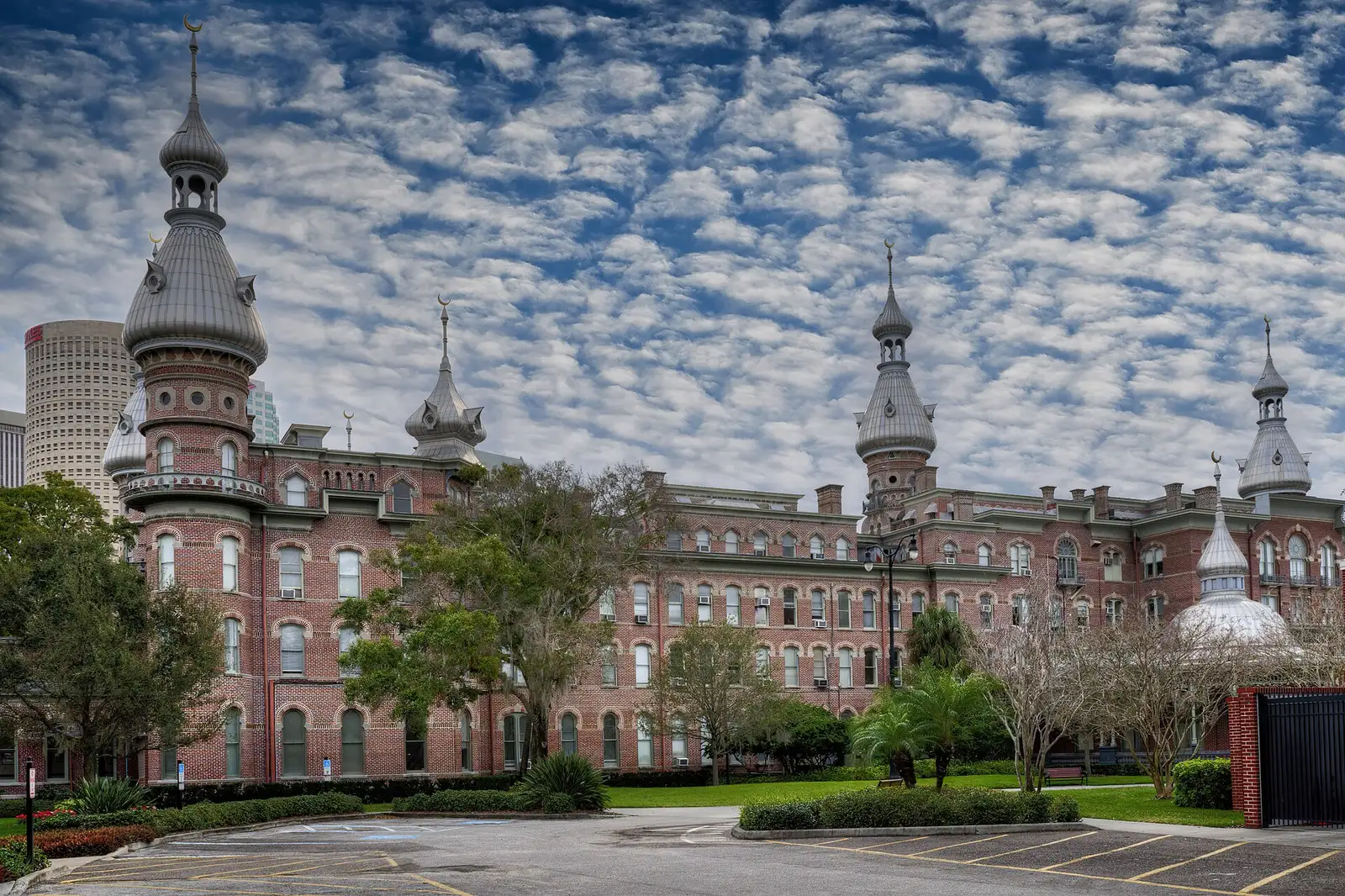
| Tampa Bay Hotel (National Historic Landmark) | 401 W. Kennedy Blvd. | 1972 |
| Union Railroad Station | 601 N. Nebraska St. | 1974 |
| Federal Building, U.S. Courthouse, Downtown Postal Station | 601 Florida Ave. | 1974 |
| Centro Asturiano | 1913 Nebraska Ave. | 1974 |
| Johnson-Wolff House | 6823 S. DeSoto St. | 1974 |
| El Centro Espanol of West Tampa (National Historic Landmark) | 2306 N. Howard St. | 1974 |
| Ybor City Historic District (National Historic Landmark) | Roughly bounded by 6th Ave., 13th St., 10th Ave. and 22nd St., E. Broadway between 13th and 22nd Sts. | 1974 |
| Stovall House | 4621 Bayshore Blvd. | 1974 |
| Leiman House | 716 S. Newport St. | 1974 |
| T.C. Taliaferro House | 305 S. Hyde Park | 1974 |
| Tampa City Hall | 315 John F. Kennedy Blvd., E. | 1974 |
| Old School House | Lafayette St., University of Tampa campus | 1974 |
| Hutchinson House | 304 Plant Ave. | 1977 |
| Tampa Theatre and Office Building | 711 Franklin St. | 1978 |
| Egmont Key | W of Tampa at entrance to Tampa Bay | 1978 |
| Anderson-Frank House | 341 Plant Ave. | 1982 |
| S.H. Kress and Co. Building | 811 N. Franklin St. | 1983 |
| West Tampa Historic District | Roughly bounded by Cypress and Ivy Sts., Fremont and Habana Aves. | 1983 |
| Hyde Park Historic Districts | Roughly bounded by Hillsborough River and Bay, Howard Ave., and Kennedy Blvd. | 1985 |
| Tampania House | 4611 N. A St. | 1985 |
| Upper Tampa Bay Archeological District | Address Restricted | 1985 |
| Masonic Temple No. 25 | 508 E. Kennedy Blvd. | 1986 |
| William E. Curtis House | 808 E. Curtis St. | 1987 |
| El Centro Espanol de Tampa (National Historic Landmark) | 1526-1536 E. Seventh Ave. | 1988 |
| LeClaire Apartments | 3013-3015 San Carlos | 1988 |
| Episcopal House of Prayer | 2708 Central Ave. | 1991 |
| Old Tampa Free Public Library | 102 E. Seventh Ave. | 1991 |
| Seminole Heights Residential District | Roughly bounded by Osborne, Florida, Hanna, and Cherokee Aves. | 1993 |
| Tampa Heights Historic District | Roughly bounded by Adalee St., I-275, 7th Ave. and N. Tampa Ave. | 1995 |
| Floridan Hotel | 905 N. Florida Ave. | 1996 |
| Hampton Terrace Historic District | Roughly bounded by Hanna Ave., 15th St., Hillsborough Ave., and Nebraska Ave. | 1999 |
| Old Tampa Children’s Home | 3302 N. Tampa Ave. | 1999 |
| Old People’s Home | 1203 E. 22nd Ave. | 2000 |
| Old Union Depot Hotel | 858 E. Zack St. | 2000 |
| SS American Victory (Victory ship) | 705 Channelside Dr, Berth 271 | 2002 |
| North Franklin Street Historic District | Roughly bounded by Florida Ave., E. Fortune, Tampa, Franklin and E. Harrison Sts. | 2002 |
| Isaac Gardner Sr. House | 209 W. Palm Ave. | 2003 |
| Meacham Elementary School | 1225 India St. | 2005 |
| Horace T. Robles House | 2604 E. Hanna Ave. | 2006 |
| George Guida Sr. House | 1516 N. Renfrew Ave. | 2006 |
| Roosevelt Elementary School | 3205 S. Ferdinand Ave. | 2006 |
| Jackson Rooming House | 851 Zack St. | 2007 |
| Old Hillsborough County High School | 2704 N. Highland Ave. | 2007 |
| St. Andrews Episcopal Church | 505 N. Marion St. | 2009 |
| Upper North Franklin Street Commercial District | Bounded by E Oak Ave, N Florida Ave, Kay St, & N Tampa St | 2010 |
| Capt. William Parker Jackson House | 800 E Lambright St | 2011 |
| Palmetto Beach Historic District | Roughly bounded by Durham, 28th, Thrace, & 22nd Sts. | 2012 |
| Perry Harvey Sr. Park Skateboard Bowl | 900 E. Scott St. | 2013 |
| Fort Homer W. Hesterly National Guard Armory | 522 N. Howard Ave. | 2013 |
| Original Rogers Park Golf Course Site | 7801 N. 30th St. | 2014 |
| Michigan Avenue Bridge | Columbus Dr. over the Hillsborough R. | 2017 |
| Oaklawn and St. Louis Cemeteries Historic District | 606 E. Harriston St. | 2017 |
| Lafayette Street Bridge | Kennedy Blvd. & Hillsborough R. | 2018 |
| First Federal Savings and Loan Association of Tampa | 220 East Madison St. | 2018 |
| Dr. Frank J. Costa House | 16116 Lake Magdalene Dr. | 2021 |
| Federal Office Building | 500 East Zack St. | 2022 |
Davis Islands (23 listings): Bay Isle Commercial Building, 238 E. Davis Blvd. (1989); House at 100 West Davis Boulevard (1989); House at 116 West Davis Boulevard (1989); House at 124 Baltic Circle (1989); House at 125 Baltic Circle (1989); House at 132 Baltic Circle (1989); House at 161 Bosporous Avenue (1989); House at 190 Bosporous Avenue (1989); House at 200 Corsica Avenue (1989); House at 202 Blanca Avenue (1989); House at 220 Blanca Avenue (1989); House at 301 Caspian Street (1989); House at 36 Columbia Drive (1989); House at 418 Blanca Avenue (1989); House at 53 Aegean Avenue (1989); House at 59 Aegean Avenue (1989); House at 84 Adalia Avenue (1989); House at 97 Adriatic Avenue (1989); Palace of Florence Apartments, 45 E. Davis Blvd. (1989); Palmerin Hotel, 115 E. Davis Blvd. (1989); Spanish Apartments, 16 E. Davis Blvd. (1989); House at 36 Aegean Avenue (1989); House at 131 West Davis Boulevard (1990).
Two listings with a Tampa mailing city sit outside the city: Egmont Key, at the mouth of Tampa Bay, and the Upper Tampa Bay Archeological District, whose location is restricted. The Costa house is on Lake Magdalene Drive.
Museums and places to visit
- Tampa Bay History Center, 801 Water St., open daily 10 a.m. to 5 p.m. (visit page).
- Henry B. Plant Museum, in the former Tampa Bay Hotel, 401 W. Kennedy Blvd. Open 10 a.m. to 5 p.m. Tuesday through Saturday and noon to 5 p.m. Sunday; closed Monday (museum site).
- Ybor City Museum State Park, run by Florida State Parks; check the park page for hours.
- Oaklawn and St. Louis cemeteries, a National Register district since 2017, at 606 E. Harrison St.
- Perry Harvey Sr. Park, 900 E. Scott St., whose skateboard bowl was listed in 2013 and whose History Walk and Leaders Row honor Tampa’s African American community.
- Old City Hall, 315 E. Kennedy Blvd., listed in 1974 and still home to the City Council chambers.
The city’s 2024 landmarks and designations book describes each local landmark.
What this means for you
- Own a house in a local historic district? Exterior changes need a Certificate of Appropriateness first; see our permits and zoning guide.
- Most National Register buildings are private; view them from the street.
- The History Center and Plant Museum are the easiest places to start.
Related: Tampa population and growth, parks and trails and getting around Tampa.
Frequently asked questions
When was Tampa founded?
Fort Brooke was set up on Tampa Bay in 1824; Col. Brooke arrived with four infantry companies on Jan. 18, 1824. Residents voted to form the Village of Tampa on Jan. 18, 1849.
When was Tampa incorporated as a city?
Florida’s governor signed the first City of Tampa charter on Dec. 15, 1855. The present city was organized on July 15, 1887, under a legislative act that merged the Town of Tampa and the Town of North Tampa.
How many National Register of Historic Places listings are in Tampa?
The National Park Service lists 82 properties with a Tampa address, from the Tampa Bay Hotel and Ybor City to 23 Davis Islands houses and buildings and the Federal Office Building, added in 2022.
What are Tampa’s National Historic Landmarks?
The Tampa Bay Hotel (designated 1976), El Centro Espanol de Tampa and El Centro Espanol of West Tampa (both 1988) and the Ybor City Historic District (1990), according to National Park Service data.
When did Ybor City start?
The city’s history page says Vicente Martinez Ybor opened a cigar factory in Tampa in 1886.
Have your say